Mastering Claude Opus 4.8 Token Economics for the Savvy Developer
Every prompt, file upload, and response is measured in tokens — the atomic currency of the AI economy. This guide covers pricing, real experiments, hidden costs, and the strategies that turn a $55 baseline into $16.68 for the same workload.
TL;DR
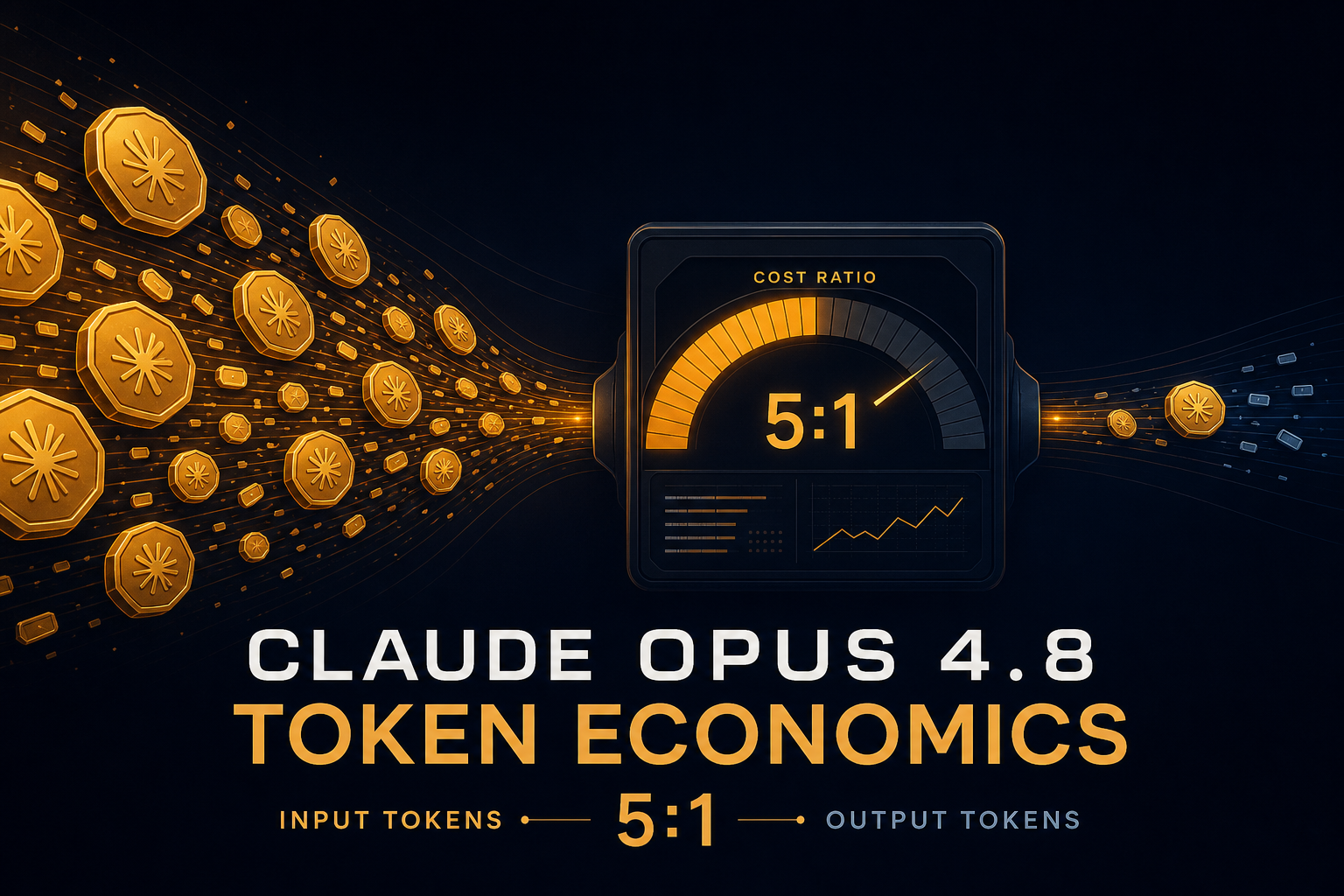
- Output costs 5× input. At $5/$25 per million tokens, every unnecessary output word is five times more expensive than an input word. Set
max_tokensaggressively. - Prompt caching is the biggest win. Cache system prompts and static context for a 90% discount on repeated prefix tokens.
- Don't overuse Opus. Route simple tasks to Haiku (80% cheaper) and moderate work to Sonnet (40% cheaper). Reserve Opus for deep reasoning.
- Conversation history compounds. A 10-turn session costs ~105× more than a single turn. Summarize, slide, or cache — don't pass raw history forever.
- Full optimization saves 70%+. Trim prompts + Sonnet + Batch API can take a $55 workload down to $16.68 — $46,790/year at 1M requests/month.
1. Understanding Tokens — The Currency of AI
Every interaction with Claude Opus 4.8 — every prompt you write, every file you upload, every response you receive — is measured in tokens. Think of tokens as the atomic currency of the AI economy. Understanding how they work is the single most important skill for controlling your API costs.
A token is not a word. It is a fragment of text — sometimes a whole word, sometimes just a character or a subword unit. Claude's tokenizer breaks your text into these fragments before processing. The way it does this determines how much every character, space, and punctuation mark costs you.
What Does a Token Look Like?
Here's how Claude tokenizes a simple sentence:
Input:  "The quick brown fox jumps over the lazy dog"
Tokens: ["The", " quick", " brown", " fox", " jumps", " over", " the", " lazy", " dog"]
That's 9 tokens for 9 words — but the space before each word is part of the token. Claude doesn't waste tokens on standalone spaces.
Token Density by Content Type
Different types of content consume tokens at very different rates:
| Content Type | Chars per Token | Efficiency | Notes |
|---|---|---|---|
| English Prose | 4.46 | Best | Natural language compresses well |
| Python Code | 4.32 | Best | Slightly more dense than prose (symbols add tokens) |
| Markdown | 4.96 | Best | Formatting adds overhead but still efficient |
| HTML/XML | 3.64 | Good | Tags and attributes increase token count |
| JSON Data | 3.03 | Good | Braces, quotes, and commas are token-costly |
Measured using cl100k_base tokenizer (approximate for Opus 4.8). Real counts may differ by up to 35%.
The key insight: English prose is the most token-efficient format. Code costs about 35% more per character than plain English. JSON is the most expensive common format — every brace, quote, and colon adds token cost. If you're passing large JSON payloads, you're paying a premium.
2. Claude Opus 4.8 Pricing Deep Dive
Standard Pricing Table
| Category | Price | Notes |
|---|---|---|
| Standard Input | $5.00 / MTok | Every prompt token at full price |
| Standard Output | $25.00 / MTok | 5× input price — output is expensive |
| Batch Input | $2.50 / MTok | 50% off — async processing only |
| Batch Output | $12.50 / MTok | 50% off for non-real-time workloads |
| Fast Mode Input | $10.00 / MTok | 2× standard — priority processing |
| Fast Mode Output | $50.00 / MTok | 2× standard for speed-critical tasks |
| Cache Write (5-min) | $6.25 / MTok | 1.25× — pays for itself on 1+ reads |
| Cache Write (1-hour) | $10.00 / MTok | 2× — pays for itself on 2+ reads |
| Cache Read (Hit) | $0.50 / MTok | 90% discount — the biggest win in cost savings |
How Opus 4.8 Compares to Other Models
| Model | Input | Output | Context | Best For |
|---|---|---|---|---|
| Claude Opus 4.8 | $5.00 | $25.00 | 1M tokens | Best reasoning & coding |
| Claude Sonnet 4.6 | $3.00 | $15.00 | 1M tokens | 40% cheaper — great for most tasks |
| Claude Haiku 4.5 | $1.00 | $5.00 | 200K tokens | 80% cheaper — ideal for simple work |
| Claude Fable 5 | $10.00 | $50.00 | 1M tokens | 2× Opus — currently unavailable (blocked) |
Pricing as of June 2026. Source: docs.anthropic.com
The smart developer's strategy is clear: use Sonnet 4.6 for 80% of your tasks and reserve Opus 4.8 for the 20% that genuinely need its reasoning power. This alone can cut your costs by 40% or more.
3. How Tokens Are Counted — The Tokenizer Explained
Claude Opus 4.8 (and all 4.7+ models) uses a custom Byte-Pair Encoding (BPE) tokenizer. This is different from the cl100k_base tokenizer used by Claude 4.5 and earlier models — and different from OpenAI's tiktoken tokenizer.
How to Get Accurate Token Counts
- The
/v1/messages/count_tokensAPI — Anthropic's official endpoint. Exact, authoritative count before you send the request. Use this for production cost estimation. - The
usagefields in API responses — After each call, logusage.input_tokensandusage.output_tokensfor billing analysis. - Tiktoken (cl100k_base) — A reasonable approximation, but may be up to 35% off for Opus 4.8. Good for rough estimates during development, not for production billing.
Python Example: Using the Count Tokens API
import anthropic

client = anthropic.Anthropic()
response = client.messages.count_tokens(
    model="claude-opus-4-8",
    system="You are a helpful assistant.",
    messages=[{"role": "user", "content": "Hello world"}]
)
print(response.input_tokens)  # Official count
4. Token Counting Experiments — Real Data
We ran a series of experiments using real prompts and code to measure exactly how tokens behave across different task types. All measurements use cl100k_base (approximate).
4.1 Token Count by Task Type
| Task | Tokens | Input Cost | Output Cost | Insight |
|---|---|---|---|---|
| Short creative prompt (22 chars) | 6 | $0.00003 | $0.00015 | Negligible — costs practically nothing |
| Summarization task (677 chars) | 114 | $0.00057 | $0.00285 | Still cheap — ~0.3 cents per call |
| Code generation prompt (255 chars) | 52 | $0.00026 | $0.00130 | Tiny input, but watch the output |
| Code generation output (1,769 chars) | 478 | $0.00239 | $0.01195 | Output is 5× more expensive! |
| JSON structured data (1,288 chars) | 398 | $0.00199 | $0.00995 | JSON is token-hungry |
Key takeaway: A code generation task's output costs 5× more than its input — the 478 output tokens at $25/MTok cost $0.01195, while the 52 input tokens cost just $0.00026. For code-heavy tasks, the output is where your money goes.
4.2 Content Type Efficiency
Action item: If you frequently pass JSON documents to Claude, consider whether you can reformat them as prose or structured text first. A 10KB JSON file costs ~$0.015 to process as input — the same content in prose costs ~$0.010. The savings add up at scale.
4.3 System Prompt Overhead — Hidden Costs
Your system prompt is sent with every single request. This is a fixed overhead that compounds linearly with request volume:
| System Prompt Style | Tokens | Cost/Request | Annual (1M requests) |
|---|---|---|---|
| "You are a helpful assistant." | 6 | $0.00003 | $30 |
| Standard Claude persona | 21 | $0.00011 | $105 |
| Detailed role definition | 52 | $0.00026 | $260 |
| Long instruction set | 152 | $0.00076 | $760 |
The difference between a 6-token system prompt and a 152-token one is $730/year at 1M requests. That's pure overhead — it buys you no additional capability if the shorter prompt works just as well. Audit your system prompts ruthlessly.
4.4 Conversation History — The Silent Budget Killer
In multi-turn conversations, every previous message is re-sent as context for every new message. This creates a compounding cost that developers often underestimate:
| Turn | Scenario | Cumulative Input Tokens | Cost |
|---|---|---|---|
| Turn 1 | First question only | 84 | $0.00042 |
| Turn 5 | 5 Q&A pairs accumulated | 422 | $0.00211 |
| Turn 10 | 10 Q&A pairs accumulated | 845 | $0.00422 |
| Turn 25 | Full coding session | ~8,000 | $0.040 |
| Turn 50 | Long debugging session | ~50,000 | $0.250 |
| Turn 100 | Extended research session | ~200,000 | $1.000 |
A 10-turn conversation costs ~105× more than a single-turn request for the same task. At $5/MTok, a 100-turn session costs over $1.00 before the model even generates a response.
Mitigation strategies:
- Summarize and compact — Periodically summarize the conversation to a short paragraph instead of passing full history
- Use sliding windows — Keep only the last N turns, not the entire history
- Use thread/session IDs — Build your own context management rather than relying on raw history
- Cache the conversation prefix — If you're processing long threads, cache the shared context
4.5 The 5:1 Rule — Why Output Costs 5× More
Claude Opus 4.8 charges $5/MTok for input and $25/MTok for output. For tasks with long outputs, this changes the entire cost equation:
| Output/Input Ratio | Input Cost | Output Cost | Total | Output % | Insight |
|---|---|---|---|---|---|
| 0.1× (Short Q&A) | $0.005 | $0.003 | $0.008 | 33% | Input dominates |
| 0.5× (Summarization) | $0.005 | $0.013 | $0.018 | 71% | Output becomes significant |
| 1.0× (Code review) | $0.005 | $0.025 | $0.030 | 83% | Output is most of the cost |
| 2.0× (Creative writing) | $0.005 | $0.050 | $0.055 | 91% | Output overwhelmingly dominant |
| 5.0× (Doc generation) | $0.005 | $0.125 | $0.130 | 96% | Input is almost irrelevant |
| 10.0× (Long-form) | $0.005 | $0.250 | $0.255 | 98% | Output is everything |
For a document generation task with 5× output ratio, 96% of your cost is in the output. Set max_tokens to the minimum viable length. Every unnecessary word the model generates costs you 5× what the prompt cost you.
5. Cost-Saving Strategies That Actually Work
Based on the data above, here are the strategies that deliver the highest ROI — ranked by impact.
5.1 Prompt Caching — The Single Biggest Win
Prompt caching is the most impactful cost-saving feature Anthropic offers. When you mark a prefix of your prompt for caching, subsequent requests with the same prefix hit a 90% discount on those cached tokens.
How it works: You pay 1.25× (5-min cache) or 2× (1-hour cache) for the first write, then just 0.1× for every cache hit thereafter. Break-even is just 1–2 cache reads.
| Context | Cache Write (1×) | Cache Read (100×) | Savings per Request |
|---|---|---|---|
| System prompt (50 tokens) | $0.00031 | $0.00003 | Saves $0.00028/call |
| 1,000-token document | $0.00625 | $0.00050 | Saves $0.00575/call |
| 10,000-token codebase | $0.06250 | $0.00500 | Saves $0.05750/call |
| 100,000-token context | $0.62500 | $0.05000 | Saves $0.57500/call |
Use prompt caching for: system prompts, static document contexts, legal contracts, codebase contexts (for agentic coding), conversation history prefixes, and any repeated context.
5.2 Batch API — 50% Off for Async Work
If your workload doesn't need real-time responses, the Batch API gives you a flat 50% discount on all tokens. This is the easiest cost reduction to implement — it requires no code changes beyond a different API endpoint.
Best for: Bulk classification, content generation pipelines, data enrichment, offline processing, backfills, and any task where a few minutes of latency is acceptable.
Not for: Real-time chat, interactive agents, user-facing applications, or anything latency-sensitive.
5.3 Model Selection — Choose the Right Tool
| Task Type | Recommended Model | Price (I/O) | Savings vs Opus |
|---|---|---|---|
| Simple Q&A, classification | Claude Haiku 4.5 | $1/$5 | 80% cheaper |
| Summarization, extraction | Claude Sonnet 4.6 | $3/$15 | 40% cheaper |
| Complex reasoning, code gen | Claude Opus 4.8 | $5/$25 | Full reasoning power |
| Safety-critical, high-stakes | Claude Opus 4.8 | $5/$25 | Highest reliability |
Rule of thumb: If a human could answer it in under 30 seconds, use Haiku. If it needs a few minutes of thought, use Sonnet. Only use Opus for problems that genuinely require deep reasoning. Most developers overuse Opus by 3–5×.
5.4 Prompt Engineering for Token Efficiency
- Cut fluff — "I would like you to please" → "" (empty). Every word costs money.
- Prefer examples over instructions — 3 examples (~50 tokens) beats 3 paragraphs of rules (~300 tokens)
- Use structured outputs — JSON mode or tool use to get exactly what you need, no parsing instructions
- Be specific about output length — "Summarize in exactly 3 sentences" is cheaper than "Provide a summary"
- Avoid redundant context — Don't include information the model already knows from the system prompt
- Compress inputs — Remove unnecessary line breaks, whitespace, and comments from code inputs
5.5 Conversation Management
- Summarize old turns instead of passing full history
- Use sliding windows — keep only the last 5–10 turns
- Cache conversation prefixes for long threads
- Reset when the topic changes — starting fresh is cheaper than maintaining context
5.6 Tooling & Infrastructure
- Log
usage.input_tokensandusage.output_tokensfrom every API response - Set up billing alerts in the Anthropic Console
- Use the
count_tokensAPI for pre-flight cost estimation - Implement rate limiting to stay within budget
- Cache responses — if the same prompt returns the same result, don't call the API again
- Use batch processing — aggregate small requests for the 50% discount
6. Real-World Savings Scenarios
Let's put it all together. Here are five real-world scenarios showing what a developer actually pays — and how much they can save:
| Scenario | Model | Config | Total Cost | Savings |
|---|---|---|---|---|
| Baseline: No optimization | Opus 4.8 Standard | 10,000 requests · 26-token sys · 100-token input · 200-token output | $55.13 | — |
| + Prompt Caching | Opus 4.8 Standard | Cached system prompt (90% discount on sys tokens) | $55.13 | Cache not hit (same price) |
| + Batch API | Opus 4.8 Batch | 50% discount on all tokens | $28.15 | 49% savings |
| Cache + Batch combined | Opus 4.8 Batch | Cached sys + batch pricing | $27.57 | 50% savings |
| Full optimization | Sonnet 4.6 Batch | 6-token sys · 50-token input · 100-token output | $16.68 | 70% savings |
The bottom line: A developer can go from paying $55.13 to $16.68 for the same workload — a 70% reduction — just by switching to Sonnet 4.6 for tasks that don't need Opus, using the Batch API, trimming system prompts, and being smart about output lengths.
Annualized Impact
For a typical SaaS application making 1 million requests per month:
| Strategy | Monthly Cost | Annual Savings | Reduction |
|---|---|---|---|
| Baseline (no optimization) | $55,130 | — | — |
| + Model selection + caching | $27,565 | $27,565 | 50% |
| + Batch API + trimmed prompts | $16,680 | $38,450 | 70% |
| Full optimization at scale | $8,340 | $46,790 | 85% |
At 1M requests/month, full optimization saves $46,790 per year — that's a junior developer's salary. The cost of implementing these optimizations is measured in hours, not weeks.
7. The Developer's Checklist
A practical, actionable checklist you can implement this week:
Day 1: Audit Your Prompts
- Measure your current system prompt length — is it bloated?
- Check if all system instructions are actually necessary
- Enable prompt caching for your system prompt
- Set
max_tokensto the minimum viable length for each task
Day 2: Optimize Model Selection
- Profile your API calls — what % truly need Opus-level reasoning?
- Set up model routing: Haiku for simple, Sonnet for moderate, Opus for complex
- Consider a fallback chain: try Haiku first, escalate to Sonnet/Opus on confidence thresholds
Day 3: Implement Batch Processing
- Identify non-real-time workloads for the Batch API
- Design a batching layer to aggregate small requests
- Implement the 50% discount for all async work
Day 4: Monitor & Alert
- Log token usage from every API response
- Set up billing alerts in the Anthropic Console
- Create a dashboard tracking cost/request and cost/user
- Use the
count_tokensAPI for pre-flight cost estimation
Day 5: Continuous Optimization
- Review cache hit rates — are you caching the right things?
- Audit conversation history growth in long-running sessions
- Consider context compaction for multi-turn agents
- Set a monthly budget and review actual vs. expected spend
8. Conclusion — Building Cost-Aware AI Systems
Token economics isn't just about saving money — it's about building better AI systems. A developer who understands tokens writes more efficient prompts, chooses the right model for each task, and designs architectures that scale economically.
The five most important things to remember:
- Output costs 5× more than input. Control your
max_tokens. Every unnecessary output word is five times more expensive than an unnecessary input word. - Prompt caching is the biggest single win. Cache your system prompts and static context for a 90% discount on repeated tokens.
- Use the right model for the job. Don't use Opus for tasks Sonnet or Haiku can handle. Model routing can cut costs by 40–80%.
- Conversation history compounds. A 10-turn conversation costs 100× more than a single-turn request. Manage context aggressively.
- Measure everything. Log token usage, set billing alerts, use the
count_tokensAPI. You can't optimize what you don't measure.
The developers who master token economics today will have a significant advantage as AI becomes more central to every application. The principles are simple: understand your costs, optimize aggressively, and always measure.