When Governments Say No: The IEEE Standards Case for Banning Gacha Games — And What Anthropic's Latest Block Means for All of Us
Two bans in June 2026 — gacha games on years of evidence, frontier AI on fear of potential harm — and the same question about when governments can say a digital product cannot exist.
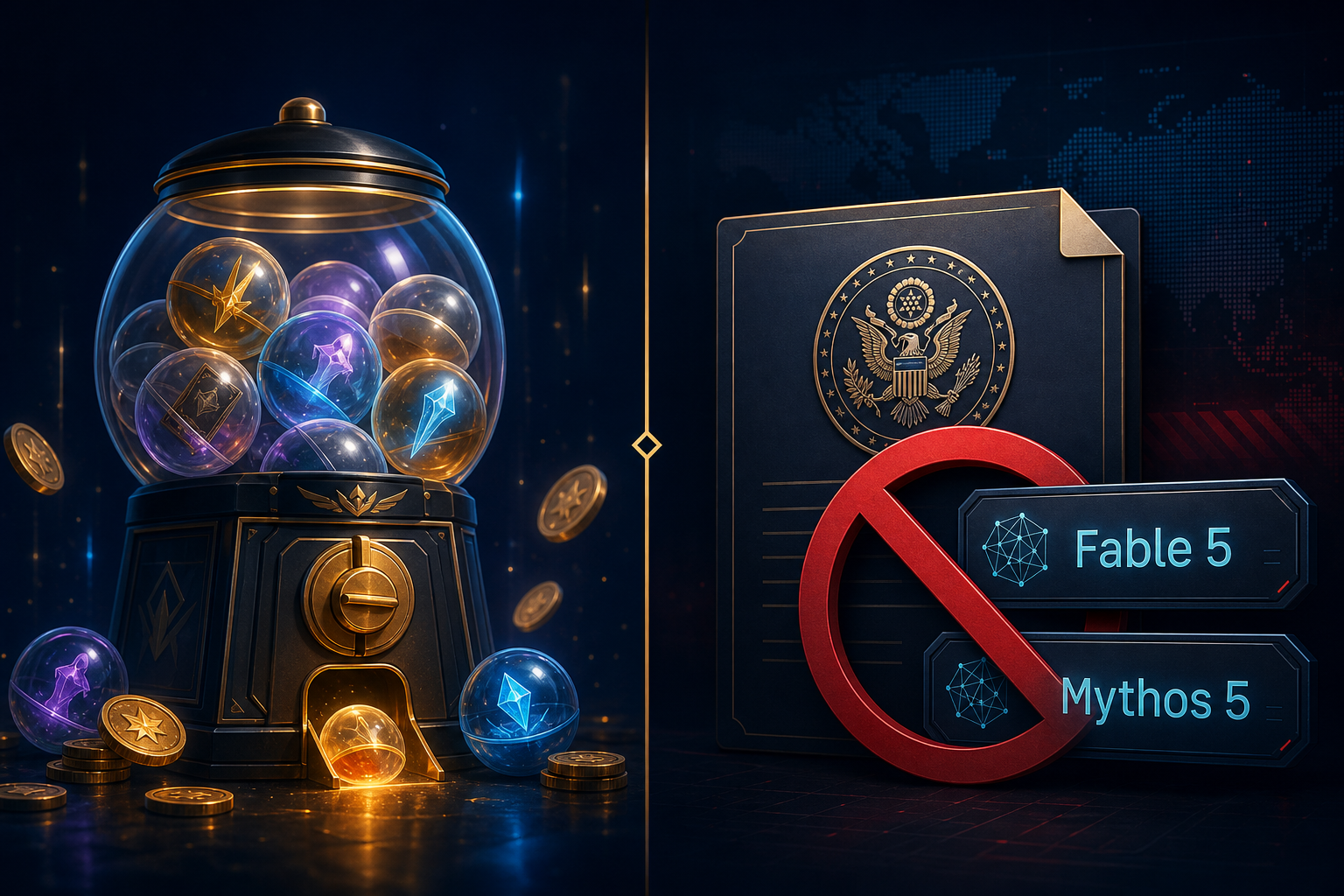
On the same week in mid-June 2026, two very different products hit the same wall: a government said no. In Mumbai, lawmakers advanced India's Online Gaming Regulation Bill — a framework that would treat certain randomized monetization mechanics as a public-health problem. In Washington, an export-control directive ordered Anthropic to suspend global access to Claude Fable 5 and Claude Mythos 5, citing a jailbreak technique that, according to Anthropic, works on other frontier models too. One ban rests on years of documented harm. The other rests on fear of potential harm. Both force the same uncomfortable question onto developers, product managers, and anyone who ships digital experiences: when does the state have the right to say a product cannot exist?
I write about enterprise AI for a living. I also grew up on the kind of free-to-play titles where you "donate" for a randomized pull and pray for a five-star character. In this piece I use Mythos and Fable 5 as a fictional pseudonym for that entire genre — the gacha machine behind titles structurally similar to Genshin Impact, Fate/Grand Order, and Honkai: Star Rail. The naming collision with Anthropic's real model names is not something I planned. It is, as we'll see, almost too on-the-nose.
Part 1: The Gacha Machine — Why Games Like Fable 5 Need Regulation
What "Mythos and Fable 5" Actually Means
When I say Mythos and Fable 5, I am not talking about Anthropic's API endpoints — at least not yet. I am describing a design pattern: a live-service game built around wishes, summons, or pulls where real money buys randomized virtual goods. You spend. The capsule spins. Maybe you get the limited character. Maybe you get a duplicate you already own three times. The house always wins on expected value; the player wins on dopamine.
These systems are engineered with the same precision as slot machines: pity counters that reset, banner FOMO, time-limited rate-ups, and social pressure from co-op content that effectively requires the latest release. Players call it "donating" because spending hundreds or thousands of dollars on pixels feels less shameful when framed as support. Regulators increasingly call it what the mathematics say it is: a monetized random-reward loop with documented addiction pathways — especially among minors.
IEEE Standards That Apply — Even Though None Mention "Gacha" by Name
The IEEE does not publish a standard titled "Stop Selling Loot Boxes to Teenagers." What it does publish is a family of documents that, read together, describe exactly why gacha mechanics fail ethical design review. Three are especially relevant:
IEEE 7000-2021 — Standard Model Process for Addressing Ethical Concerns During System Design. This is not a checklist you paste into a Jira ticket. It is a process standard: identify stakeholders, surface value tensions early, and document trade-offs before you ship. Applied to gacha, the ethical concern is not "randomness exists in games." Candy Crush tiles are random. The concern is monetized randomness tied to real currency, with asymmetric information and no cash-out. IEEE 7000 asks whether you designed for the child who cannot consent to compound interest on a credit card, not just the whale who can. Most gacha pipelines never run that process. They run A/B tests on banner art.
IEEE 7010-2020 — Recommended Practice for Assessing the Impact of Autonomous and Intelligent Systems on Human Well-Being. Well-being here is measurable: sleep, financial stress, social isolation, cognitive load. Peer-reviewed literature on loot boxes now includes meta-analyses linking purchase behavior to problem-gambling scores — not correlation cosplay, but effect sizes regulators cite in court. IEEE 7010 gives you a vocabulary to quantify harm: who is affected, how severely, and whether mitigations actually work. A "spending cap" that resets every banner is not a mitigation. It is a speed bump on the way to the pity threshold.
IEEE 7001-2021 — Transparency of Autonomous Systems. Players rarely see true drop rates until a scandal forces disclosure. They do not see dynamic pricing. They do not see how pity interacts with soft currency conversion. IEEE 7001 demands that systems making consequential decisions be explainable to the humans subject to them. A gacha screen that shows a cute animation instead of expected value per dollar is the opposite of transparency. It is UX designed to obscure the IEEE 7001 failure mode.
Critical gap: no IEEE standard specifically addresses gaming addiction or minor protection in interactive entertainment. The frameworks exist; the domain-specific profile does not. That absence is itself an argument for government action — industry self-regulation has had fifteen years and produced pity timers, not safety.
The Global Regulatory Picture (June 2026)
- India (2025 bill, advancing in 2026): The Online Gaming Regulation Bill distinguishes games of skill from games of chance and targets real-money stakes and predatory monetization. Randomized paid pulls sit in the crosshairs of committee debate — not banned outright yet, but licensing, age gates, and spend disclosures are on the table.
- China: The comprehensive model everyone cites — strict play-time limits for minors, approval requirements for new titles, caps on spending, and reporting obligations. Gacha still exists, but inside a cage regulators redraw whenever engagement metrics spike.
- Brazil (2025–2026): A loot-box ban for minors took effect, treating certain randomized purchases as gambling-adjacent for under-18 users. Publishers must implement age verification or remove the mechanic for that cohort.
- Belgium: Declared loot boxes gambling under existing law; several publishers pulled paid loot boxes from the market rather than comply. The EU's patchwork means Belgium is strict while neighbors are softer — but the legal precedent stands.
- Netherlands: Similar gambling-classification fights; enforcement has wavered, but the policy direction aligns with Belgium — randomized paid rewards trigger licensing questions.
- United Kingdom: No outright ban, but the Gambling Commission and DCMS reviews pushed for transparency and age checks; political pressure continues after documented minor spending cases.
- Australia: State-level gambling law probes; industry codes tightened; parliamentary reports recommend treating loot boxes like gambling products for minors.
- United States: No federal action as of June 2026. FTC workshops, state bills, and class actions rumble through courts, but Congress has not passed a national framework. The gap is conspicuous given how much mobile gacha revenue is US-sourced.
Why IEEE Frameworks Support Regulation — Four Arguments
- Process failure (IEEE 7000): Gacha economies are optimized for revenue, not stakeholder ethics review. If you never document the child-as-stakeholder, you never design for them.
- Measured harm (IEEE 7010): Well-being impact is not hypothetical. Financial harm, sleep disruption, and gambling-adjacent behavior show up in data regulators can cite.
- Transparency failure (IEEE 7001): Opacity is a feature, not a bug. Mandating odds disclosure, spend history, and minor-specific friction is correcting a known design violation.
- Standards gap: Because IEEE has no gaming-specific addiction standard, voluntary compliance has no anchor. Government rules become the default backstop — exactly as they did for tobacco, and exactly as they may for AI.
Part 2: The Anthropic Fable 5 Ban — A Very Different Kind of Block
What Happened
Between June 12 and 15, 2026, the US government issued an export-control directive ordering Anthropic to suspend access to Claude Fable 5 and Claude Mythos 5 worldwide — not merely for government customers, not merely inside the United States, but globally. The stated reason: a jailbreak technique that could, in theory, strip safety guardrails from the models. Anthropic complied immediately. Both models went dark for API consumers, Claude Max subscribers, and enterprise deployments that had spent the previous week migrating workloads to Fable 5 after its June 9 launch.
Anthropic's public response was measured but firm. The company argued the cited jailbreak was neither novel nor Fable-specific — researchers had demonstrated similar bypasses on other frontier systems. Flying staff to Washington to negotiate was not performative; when your flagship SKUs disappear overnight, you get on a plane. Reports that Amazon — a major Anthropic partner and cloud distributor — had warned the White House about the models added a corporate subplot: platform politics now shape export policy the way carrier exclusives once shaped handset launches.
Meanwhile, the rest of Anthropic's news cycle did not pause. Claude Opus 4.8 continued shipping as the stable fallback. Enterprise partnerships with TCS and DXC were announced even as Fable 5 sat behind a government cordon. A class-action lawsuit over Claude Max's $200/month tier alleged that "unlimited" usage was throttled — a consumer-protection angle orthogonal to export control but damaging to trust. And Anthropic confidentially submitted a draft S-1 for an IPO, which means lawyers in two directions: securities disclosure and national-security review.
Cybersecurity leaders — including voices from the defensive side of the industry — publicly urged lifting the ban, arguing that Fable 5's security-research capabilities were an asset, not a liability. The irony of banning a model marketed partly for cyberdefense because it might be jailbroken is not lost on anyone who reads CVE mailing lists.
The Connection
Strip the surface differences and both stories are structurally identical:
- A digital product ships at scale.
- Evidence or allegation of harm emerges — years of addiction research for gacha; days-old jailbreak research for Fable 5.
- The state intervenes with the heaviest tool available: prohibition, or something close to it.
- Industry argues for self-regulation, mitigation, and transparency instead of shutdown.
- Users suffer collateral damage — minors who genuinely enjoy games without overspending; enterprises with production pipelines pinned to a model that vanished over a weekend.
The gacha ban (where it exists) is justified with longitudinal harm data and IEEE-aligned ethical critiques. The AI ban was justified with a hypothetical abuse path and a geopolitical lever export law provides. Both raise the same constitutional and economic question for developers: is the cure proportionate to the disease? Belgium answered yes for loot boxes. Washington answered yes for Fable 5 — at least temporarily. Developers who assume "legal to ship" equals "safe to build a business on" learned otherwise in both domains this month.
The Irony
Anthropic named its frontier models after myth and story — Fable, Mythos — the same vocabulary mobile game marketers use for seasonal events and limited banners. So when headlines read Government Bans Fable 5 and Mythos, half of Twitter thought it was about gacha. The other half thought it was about AI. They were both half right.
I have spent this entire essay using Mythos and Fable 5 as a pseudonym for gacha games — and now the US government has literally banned products with those exact names, except they are large language models, not gacha banners. The collision is absurd enough to be funny until you remember real companies lost real revenue in both cases. The fantasy RPG naming convention was cute when it was marketing. It is less cute when export control treats your product title like a munitions designation.
Part 3: What the Anthropic Block Teaches Us About Game Regulation
If you build games, platforms, or AI tooling, the Fable 5 block is a preview of how fast the Overton window can slam shut — and what gacha regulation advocates have been saying for years.
- Speed vs. evidence. Gacha regulation moves slowly because harm evidence accumulates across studies, jurisdictions, and cohorts. The Fable 5 ban moved in days on a single exploit class. Regulators tolerate different evidence bars for different anxieties — gambling harm is proven; AI misuse is feared. If you ship in a feared category, assume fast reflexes.
- Disproportionate impact. A global export ban on a model is a sledgehammer. So is removing loot boxes entirely instead of mandating odds disclosure and minor friction. Both policies punish compliant users alongside abusive edge cases. Design for graceful degradation: if your revenue model requires the one feature regulators hate most, you have a single point of failure.
- Unintended consequences. Anthropic's IPO timeline, enterprise contracts, and consumer lawsuits all intersect with a model ban nobody priced into June. Gacha bans push publishers toward battle passes and direct sales — sometimes more extractive, just less random. Regulation reshapes markets; it does not always simplify them.
- The standards gap. IEEE gives gacha critics a language but not a gaming-specific enforcement hook. AI safety has NIST, export control, and frontier labs' own policies — fragmented, but present. Until IEEE (or ISO, or national bodies) publishes domain-specific profiles, governments will keep improvising. Developers should participate in standards drafting or accept improvised rules.
For a deeper technical look at what Fable 5 actually is — benchmarks, the Mythos split, pricing — see our launch analysis from June 9. This piece is about the policy envelope around the product, not the product itself.
Latest Update: What's Happening Right Now (June 14–15, 2026)
Anthropic / AI front
- Export-control directive active: Claude Fable 5 and Claude Mythos 5 remain suspended globally pending negotiations; Anthropic staff in Washington seeking scope limits or time-bound mitigations.
- Jailbreak dispute: Anthropic maintains the cited technique is generic across frontier models; cyber-defense advocates argue banning Fable 5 removes a tool from defenders' hands.
- Amazon factor: Reports of Amazon briefing the White House on model risk — partnership politics now part of the regulatory story.
- Claude Max lawsuit: Class action over $200/month "unlimited" throttling continues; separate from export control but compounds brand risk ahead of IPO.
- IPO track: Confidential S-1 filed; national-security review and disclosure obligations now tied to model-access policy.
- Opus 4.8 + enterprise: Fallback model stable; TCS and DXC partnership announcements signal enterprise motion continues despite flagship block.
Games regulation front
- India: Online Gaming Regulation Bill in committee; randomized monetization and real-money mechanics under scrutiny — expect disclosure and age-verification requirements even if outright gacha ban fails.
- Brazil: Minor-facing loot-box ban in force; publishers implementing verification or geo-fencing.
- China: Continued tightening of minor play-time and spend caps; new title approvals slow for games with aggressive gacha loops.
- EU patchwork: Belgium precedent holds; Netherlands and UK pressure continuing; no unified EU gacha ban yet.
- United States: Still no federal loot-box law; state-level bills and FTC attention continue — the outlier among major revenue markets.
Bottom line
Two industries, two bans, one lesson: the state will say no — sometimes with years of IEEE-aligned evidence, sometimes with a weekend's fear. If you build digital products, the design question is no longer "can we ship it?" but "what happens to our users, and our business, the day someone with a seal says we can't?"